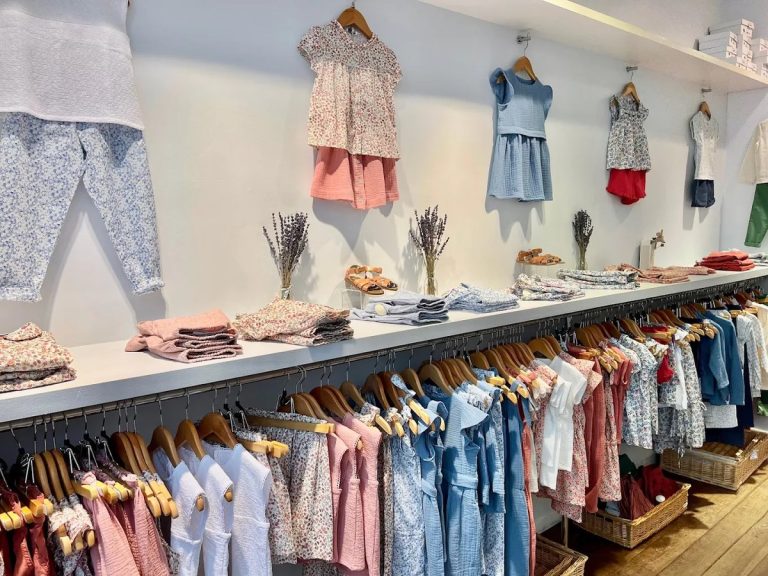
This is our editors’ guide to dressing children for formal occasions in 2026 — what holds up in family photographs, what gets the proportions right, and what the most experienced grandmothers we know would quietly steer you toward.
The single rule: simpler than you think
The most common mistake parents make with formal children’s wear is overcorrection. A four-year-old at a black-tie wedding does not need to look like a miniature adult in a three-piece suit. The pieces that age well in photographs — and that the child will actually consent to wear — are the ones that respect the proportions of childhood.
Boys’ formal wear in the under-eight range is at its best in tailored shorts rather than long trousers: ivory or cream linen for summer weddings, charcoal or navy wool for winter formality. A simple white button-front shirt, a knee-length sock, and a polished leather lace-up will outclass any miniature tuxedo every time. Marie-Chantal, Pepa & Co, and Amaia Kids remain the houses that understand this best.
Girls' formal: the silk-cotton spectrum
For girls’ formal wear, the spectrum runs from soft cotton-poplin party dresses for under-fives to the silk-and-tulle special-occasion pieces designed to read in evening photographs. Both work — but rarely together.
For under-fives: cotton-poplin or velvet, with a smocked yoke or simple gathered waist, in ivory, dusty pink, sage green, or navy. Bonpoint‘s special-occasion line is the standard; Caramel‘s tea-dyed broderie dresses are the editor’s-choice alternative for the family who prefers something quieter.
For seven-to-twelve year olds: silk taffeta or silk-blend pieces, often with subtle structure at the waist. The classic Christmas dress from Marie-Chantal or Trotters remains the right answer for British families; Charabia and Tartine et Chocolat are the French equivalents.
The christening: a category of its own
Christening gowns and naming-ceremony pieces are the one occasion in childhood formalwear where extreme tradition is rewarded. The pieces are worn once, photographed forever, and often passed down across generations.
The houses still making proper christening gowns by hand: Bonpoint’s couture atelier on Rue de Tournon in Paris, Pepa & Co (Spanish heritage, hand-embroidered), La Coqueta, and the long-established London tailor Confiance. Expect to spend $400-$1,200 for a christening gown that will pass to a younger cousin in twelve years and still photograph as a museum piece.
What to avoid
Three categories of formal children’s wear consistently disappoint in photographs and don’t age well:
- Miniaturised adult suits with logoed details. A child in a designer-branded blazer looks like a piece of advertising, not a family member.
- Heavy synthetic fabrics (polyester satin, structured polyester taffeta). They photograph plastic, they don’t move with the child, and they don’t last past the occasion.
- Costume-adjacent dressing (oversized bows, three-tier skirts, novelty themes). These read as costume in retrospect, even when they photograph well in the moment.
The shoes question
Children’s formal shoes are the detail that most often undermines an otherwise well-considered look. The non-negotiable: real leather, polished, with a closed toe. Pretty Originals, Manuela de Juan, and Step2wo remain the standard for British formal-occasion shoes. Aster (French) and Pèpè (Italian) are the continental equivalents. Expect $100-$220 for a shoe that will survive multiple occasions across a year.
The grown-up trick: let the child move
The last piece of advice from our editors who have dressed their own children for hundreds of formal occasions: leave the child enough room to actually move. The single best photograph of a child at any formal occasion is the candid one — the moment they break away from the family group, laugh, run across the lawn, or sit down on the church steps. None of this happens in a constrictive outfit. The investment in formal children’s wear is partly an investment in giving them permission to still be themselves.